
Every casino game is a probability problem with the answer printed on the table. Once you know how to read it, you understand why casinos make money year after year, why some players still walk out winners, and how to calculate the real price of a night at the tables. It is also the best introduction to expected value you will ever get, and expected value is the idea behind insurance, investing, sports analytics and half of economics.
Expected value in one sentence
The expected value (EV) of a bet is what you would win or lose on average per bet if you could repeat it forever. You calculate it by multiplying each possible outcome by its probability and adding them up.
The house edge is simply the negative EV of a bet expressed as a percentage of the stake. A house edge of 5 percent means that, on average, you lose 5 cents of every dollar you bet.
Worked example: American roulette
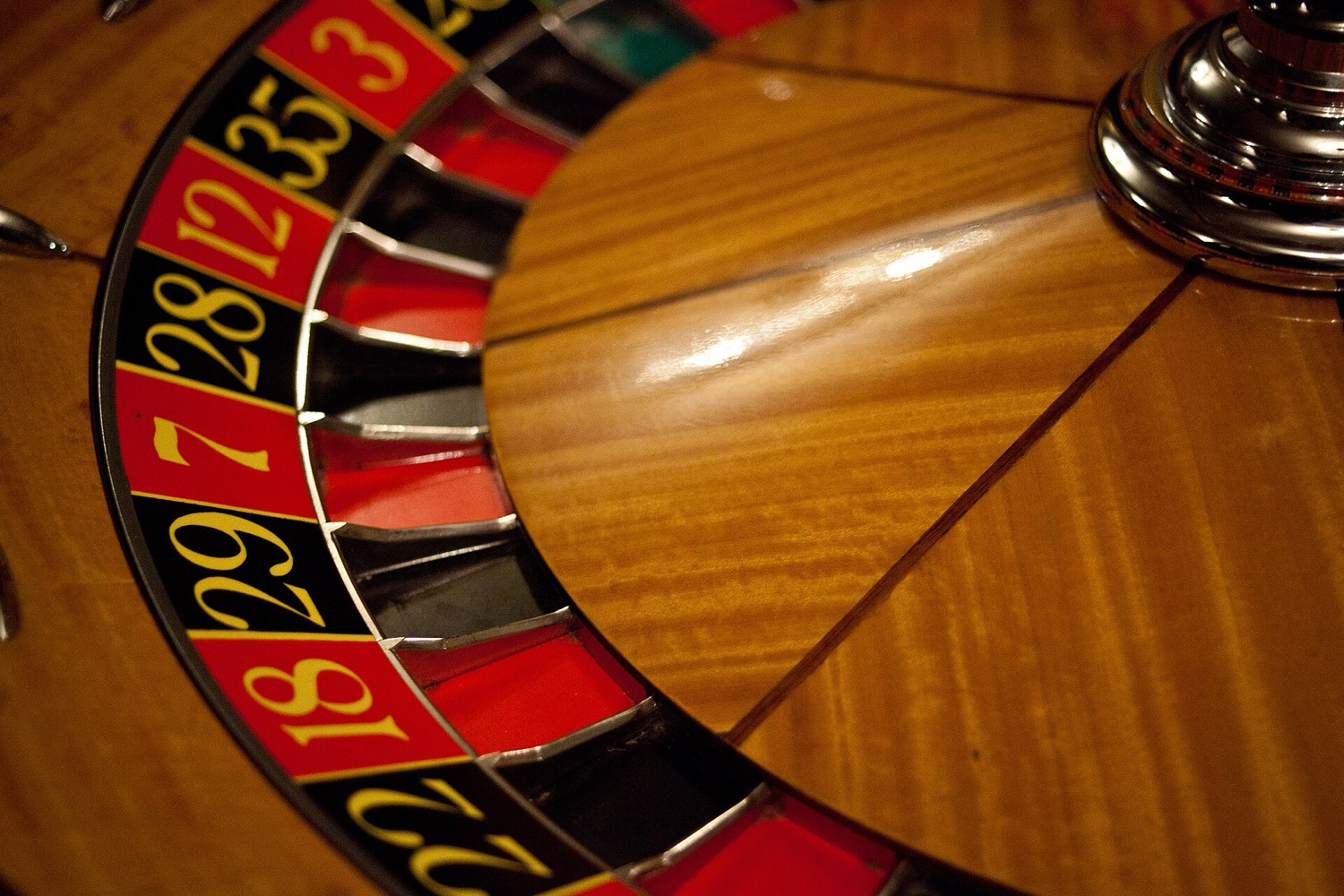
An American roulette wheel has 38 pockets: the numbers 1 to 36 plus 0 and 00. A bet on a single number pays 35 to 1.
So the house edge is 5.26 percent. Now try a bet on red. There are 18 red pockets, 18 black and two green zeros, and red pays even money:
Exactly the same. That is not a coincidence: almost every bet on an American wheel is priced so that the two green pockets are the house's profit. A European wheel has only one zero, 37 pockets in total, so its edge is 1/37, or 2.70 percent, about half. Some French tables return half of an even-money bet when zero comes up, cutting the edge on those bets to about 1.35 percent. The worst bet on the American table is the five-number bet on 0, 00, 1, 2 and 3, with an edge of 7.89 percent.
The house edge across the casino floor
| Game and bet | Approximate house edge | Why |
|---|---|---|
| Blackjack with perfect basic strategy | about 0.5% (varies with rules) | Dealer acts last; player busts first |
| Baccarat, banker bet | 1.06% | 5% commission on banker wins |
| Baccarat, player bet | 1.24% | Banker's drawing rules are slightly better |
| Craps, pass line | 1.41% | Rolls of 2, 3 and 12 on the come-out |
| European roulette | 2.70% | One green zero |
| American roulette | 5.26% | Two green zeros |
| Slot machines | often 5–15% | Set by the machine's programmed return |
| Baccarat, tie bet (pays 8 to 1) | about 14.4% | True odds are closer to 9.5 to 1 |
| Keno | often 25% or more | Payouts far below true odds |
Blackjack's low edge only applies if you play perfect basic strategy. Typical players make enough mistakes to give the house 2 percent or more, and tables that pay 6 to 5 instead of 3 to 2 on a blackjack add roughly another 1.4 percent. Slots are different again: the return to player is programmed into the machine, and some states set legal minimums (Nevada's is 75 percent), but the exact figure for a given machine is usually not displayed.
The law of large numbers
If the house has an edge on every bet, how does anyone ever win? Because the edge is an average, not a guarantee. On a single spin of roulette you either win or lose; the 5.26 percent only shows up over many spins. In the short run, luck dominates. In the long run, the maths dominates. That is the law of large numbers, and it is why a casino, which takes millions of bets a week, can predict its profits almost to the percentage point, while an individual player on a single night cannot predict theirs at all.

Variance: why winners exist
Variance measures how widely results swing around the average. Betting $10 on a single number has the same EV as betting $10 on red, but far higher variance: you will lose most of the time and occasionally win big. Slots are high-variance by design, because the occasional jackpot is what makes them exciting. Low-variance bets, such as even-money bets or the banker bet in baccarat, give a smoother ride with smaller swings.
Two myths the maths destroys
- The gambler's fallacy. After ten reds in a row, black is not "due". The wheel has no memory; each spin is independent. In a famous 1913 night at Monte Carlo, black reportedly came up 26 times in a row, and players lost fortunes betting that red was overdue.
- Betting systems. The Martingale system, doubling your bet after every loss, feels like it cannot fail. But a long losing streak, which is rare but certain to happen eventually, hits either your bankroll limit or the table maximum. No staking system changes the EV of the underlying bet, because the sum of negative-EV bets is still negative.
Calculate the real cost of a night out
Here is the most useful formula on this page:
A player betting $10 a hand at blackjack, playing about 70 hands an hour with good basic strategy (0.5 percent edge), expects to lose about $3.50 an hour. The same $10 on American roulette at about 40 spins an hour costs around $21 an hour. A $1 slot spun 600 times an hour at an 8 percent hold costs about $48 an hour. That is how you compare a casino night with a concert or a meal out, and it is the heart of our guide to budgeting your entertainment money.
Where the edge can flip
A handful of situations let skilled players turn the edge in their favour. In blackjack, the cards that have already been dealt change the odds of the cards to come, which is the basis of card counting: see our story of the MIT blackjack team. In poker, you play against other players, not the house, so better players win over time: see poker as a game of skill. And in sports betting, the price is set by people and markets that can be wrong: see how odds and the vig work.
Classroom exercise: calculate the house edge on a European roulette bet on a "dozen" (12 numbers, pays 2 to 1). Answer: (12/37 × 2) − (25/37 × 1) = −1/37, or 2.70 percent, the same as every other standard bet on the wheel.